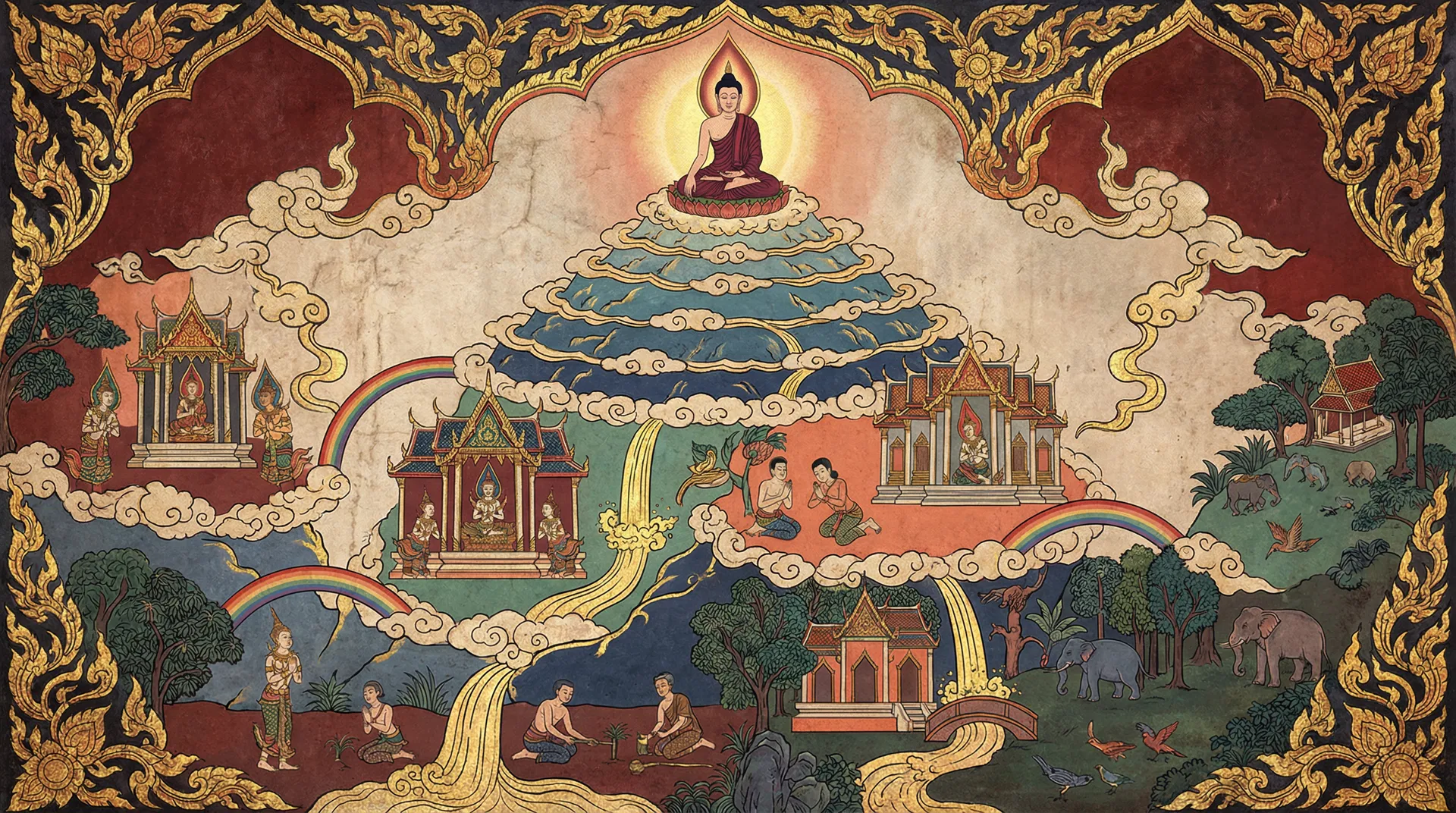
Mahā-pankatthera Jātaka
The Tale of the Bodhisatta Who Endured the Muddy Path
In the ancient city of Jetuttara, a great Bodhisatta once lived, destined to become the Buddha. In that lifetime, he was born as the son of a wealthy merchant family, destined for a life of comfort and ease. His parents, loving and doting, ensured he lacked for nothing, showering him with every conceivable luxury. The young Bodhisatta, however, was not swayed by material possessions. From a young age, he possessed a remarkable inner strength and a deep sense of compassion for all beings.
As he grew, he witnessed the suffering that existed even within the gilded cage of his privileged life. He saw the struggles of the servants in his household, the hardship of the farmers who supplied their wealth, and the general injustices that plagued the world outside his mansion walls. This stirred within him a profound desire to alleviate suffering and to find a path that led beyond the cycles of birth and death.
One day, a venerable ascetic, known for his profound spiritual insights and his ability to endure great hardship, arrived in Jetuttara. This ascetic had dedicated his life to rigorous self-discipline and meditation, seeking enlightenment. The young Bodhisatta, hearing of the ascetic's wisdom, felt an immediate connection and sought him out.
“Venerable sir,” the Bodhisatta addressed the ascetic with deep respect, “I am drawn to your path. I wish to understand how one can overcome suffering and attain true peace. I have lived a life of comfort, yet my heart yearns for something more profound.”
The ascetic, recognizing the earnestness and purity of the young man’s heart, smiled gently. “The path to true peace,” he replied, “is not paved with ease and comfort. It requires unwavering determination, immense patience, and the willingness to endure trials that would break lesser spirits. It is a path often fraught with obstacles, much like walking through deep mud.”
The Bodhisatta listened intently. “I am willing to endure any hardship,” he declared, his voice firm. “Tell me what I must do.”
The ascetic then proposed a rigorous test. He led the Bodhisatta to a vast, muddy plain outside the city, a place notorious for its treacherous, sticky mud that clung to everything. “Here,” the ascetic instructed, “you must walk across this plain, from one end to the other. You must not falter, you must not complain, and you must not turn back, no matter how difficult it becomes. You must carry this heavy stone,” he said, gesturing to a large boulder, “as a symbol of the burdens we carry in life. This is your training.”
The Bodhisatta accepted the challenge without hesitation. He picked up the heavy stone, its weight pressing down on him, and stepped into the thick, clinging mud. The going was agonizingly slow. With each step, the mud pulled at his feet, threatening to swallow him whole. The stone was a constant, crushing weight. His muscles ached, his skin grew raw, and the sun beat down relentlessly. Sweat poured from him, mixing with the mud that caked his body.
Doubt occasionally flickered in his mind. He saw others easily traversing the firmer ground at the edges of the plain, their lives seemingly free from such arduous struggle. He felt the temptation to abandon the path, to seek an easier way. But then he remembered the ascetic’s words and his own sincere desire to alleviate suffering. He focused on his breath, on the task at hand, and on the noble purpose that drove him.
He recalled the suffering of all beings, the arduous journey of countless lives. He saw the mud not as an enemy, but as a teacher, teaching him perseverance. He saw the stone not as a burden, but as a symbol of the karma and defilements he needed to overcome. He endured. Hours turned into what felt like days. The sun began to set, casting long shadows across the muddy expanse, yet he pressed on, his determination a burning flame within him.
Finally, after what seemed an eternity, the Bodhisatta reached the other side of the plain. He stood, exhausted but triumphant, his body covered in mud, the heavy stone still clutched in his hands. The ascetic met him there, his face filled with a mixture of approval and profound admiration. “You have done well, my son,” the ascetic said, his voice filled with warmth. “You have shown that the most difficult paths can be traversed with unwavering resolve. You have endured the mud, and you have carried the weight. You have learned the first lessons of true spiritual progress.”
From that day forward, the Bodhisatta continued his spiritual training under the ascetic, applying the same unwavering determination and endurance to all his endeavors. He understood that the path to enlightenment was indeed like walking through mud, requiring constant effort and the willingness to overcome every obstacle, no matter how daunting. His willingness to endure such hardship, to face the muck and mire of existence with unwavering resolve, was a testament to the immense patience and determination he cultivated, laying the foundation for his future enlightenment.
The path to spiritual realization is often arduous and challenging, like traversing a muddy plain. True progress is made through unwavering determination, immense patience, and the courage to endure all obstacles without complaint.
— In-Article Ad —
💡Moral of the Story
Unwavering determination and immense patience are essential to overcome life's challenges and progress on the spiritual path.
Perfection: Patience (Khanti) and Resolve (Adhitthana)
— Ad Space (728x90) —
More Jataka Tales You May Enjoy
 212Dukanipāta
Mulasutta Jataka
The Root of All EvilIn the prosperous city of Varanasi, ruled a king known for his immense wealth an...
💡 Greed and envy are the root of all evil, leading to deception, loss, and suffering. True contentment comes from appreciating what one possesses and cultivating inner virtue.
 416Sattakanipāta
Mugapakkha Jataka
The Tale of the Mute AsceticIn the ancient city of Varanasi, nestled beside the sacred Ganges, lived...
💡 Understanding and compassion can solve problems where force fails. True wisdom often communicates without words.
 269Tikanipāta
Kacchapa Jataka
Kacchapa JatakaIn the ancient kingdom of Savatthi, nestled amidst rolling hills and fertile plains, ...
💡 True peace and contentment arise from accepting the impermanence of all things and acting with diligence but without attachment to outcomes.
 1Ekanipāta
The Tale of the Great Lotus
The Tale of the Great Lotus In a time long past, when the world was a canvas of verdant forests and...
💡 Impatience is like a fire that burns everything, but wisdom and concentration are the tools that allow us to control situations and achieve goals with stability.
46EkanipātaThe Bodhisatta as the Weaver Bird
The Bodhisatta as the Weaver BirdIn the lush green canopy of a sprawling banyan tree, where sunlight...
💡 Diligence, honesty, and compassion are the foundations of true security and a virtuous life.
137EkanipātaMaha-Ummagga Jataka
The Great Wisdom of Prince VessantaraIn the ancient kingdom of Kalinga, famed for its glittering cit...
💡 The highest form of generosity is to give even that which is most precious, understanding that true happiness lies in selfless giving and compassion for all beings.
— Multiplex Ad —